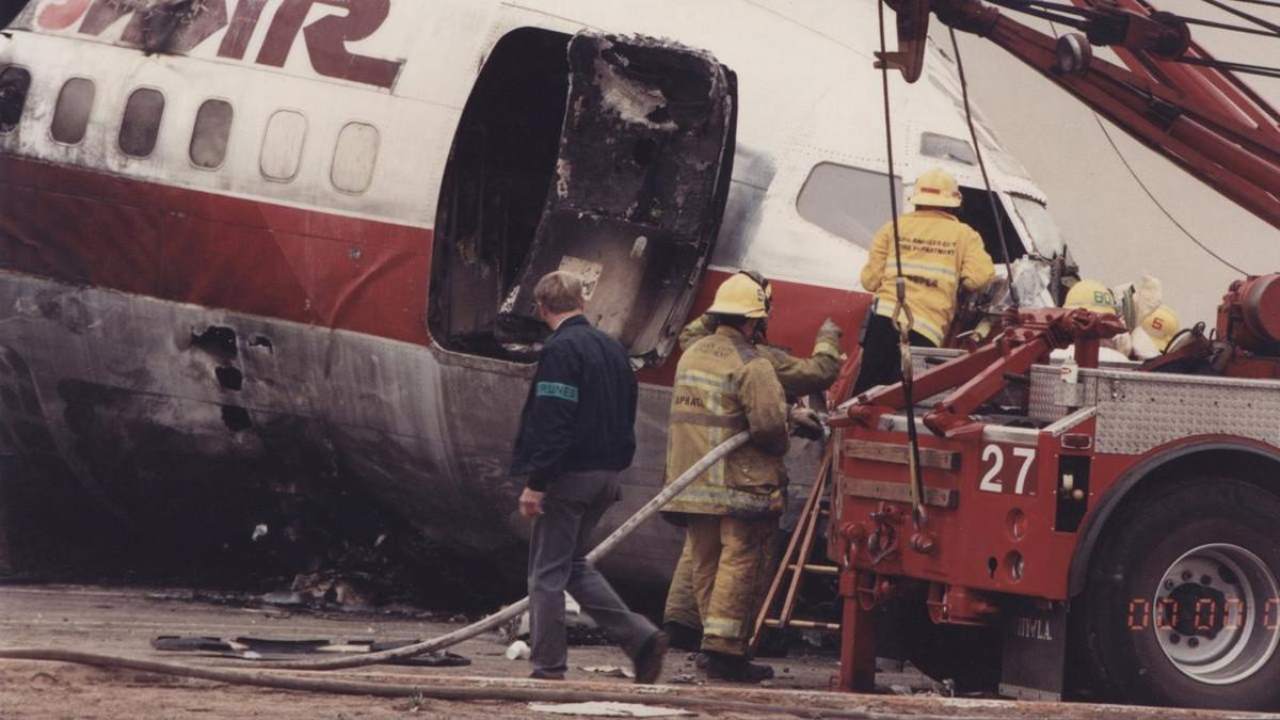
Naturally, a list of accidents deadliest aircraft in history should serve as a reminder that life is fragile.

top 10 wrost aircrashes in history
Air transport is considered as one of the safest means of transport, with the least amount of deaths per miles traveled. However, from time to time, stories of the horrific aircraft crashes are the news. History has had its fair share of aviation disasters and we’ve compiled the worst ten tragedies, according to the balance sheet of each accident.
1. Turkish Airlines flight 981 (1974)
Turkish Airlines flight 981 crashed just outside Paris, in March 1974, killing all 346 people aboard. Investigators found that the cargo hatch back the McDonnell Douglas DC - 10 has exploded, causing decompression, severing cables and leaving drivers without control of the ship.

Turkish Airlines Flight 981 (1974)
Lasting impact: following the accident, the locks on the hatch of loading on McDonnell Douglas DC-10 aircraft were re-designed and improved locking system significantly after it was found that a failure of the hatch could easily lead to the collapse of the floor and disturbance of the controls. Subcontractor fuselage, Convair, knew the design flaw and has informed the McDonnell Douglas of the potential problem, but ignored due to the cost and time of delivery of the aircraft. The case is now widely studied in the field of engineering ethics.
2. Disaster of Tenerife Airport (1977)
It was the explosion of a bomb at the nearby airport of Gran Canaria which forced KLM flight 4805 and Pan Am flight 1736 to divert to the airport Los Rodeos (now Tenerife North Airport) on March 27, 1977, for what might have to reveal a fateful day. A dense fog, lack of radar on the ground at the airport and several communication errors led to passenger plane of two Boeing 747s collided on the runway in what remains to this day the deadliest accident in the history of commercial aviation. All 248 passengers and crew aboard the KLM flight were killed and 335 of 396 people on flight Pan Am, resulting in a huge number of deaths of 583.

Tenerife Airport Disaster (1977)
Lasting impact: air traffic control phraseology has been normalized to reduce the risk of misunderstandings, who were suspected to have played a crucial role in the events that led to the accident. The disaster also led to the concept of Crew Resource Management and gave less experienced crews more than latitude to challenge their masters if they believed that something was wrong.
3. American Airlines Flight 191 (1979)
American Airlines Flight 191 crashed just minutes after takeoff from Chicago o’ Hare, may 25, 1979, when the engine number-one on the left wing of the McDonnell Douglas DC-10 separated and spilled on the top of the wing, rupture of the hydraulic lines and damage the aircraft. All 258 passengers and 13 crew members were killed, and the crash remains the most devastating air disaster on American soil.

American Airlines Flight 191 (1979)
Lasting impact: investigators attributed the separation of the engine to faulty maintenance at American Airlines procedures. The subsequent grounding of all DC - 10 of the Federal Aviation Administration revealed several other aircraft in the damage caused by the same faulty maintenance procedure that has condemned the American Airlines flight. The problem was finally fixed even though the DC-10 suffered from a bad reputation for many years to come.
4. Air New Zealand flight 901 (1979)
From 1977 to 1979, Air New Zealand has operated a so-called ‘flight to nowhere’ by looping over the Antarctic and returned Auckland via Christchurch airport. The tourist route ceased to exist after Air New Zealand flight 901 collided with Mount Erebus, on Ross Island, Antarctica, killing all 237 passengers and 20 crew on board. The accident remains the deadliest disaster in peacetime of New Zealand.

Air New Zealand Flight 901 (1979)
Lasting effect: A preliminary investigation concluded that the accident was the result of pilot error, but the outcry led to a Royal Commission of inquiry which uncovered “a litany of lies orchestrated” by Air New Zealand, which has led to major changes in all the airline executives. The commission found that the coordinates of the flight path had been amended on the eve of the disaster, although the crew was not informed of the change. Instead of the McDonnell Douglas DC - 10 amounting to McMurdo Sound, it was re-routed directly into Mount Erebus.
5. Saudi Arabian flight 163 (1980)
All 287 passengers and 14 crew aboard Saudia Arabian flight 163 died after the Lockheed L-1011 TriStar caught fire after takeoff from the Airport International of Riyad (now Riyadh Air Base) in August 1980. The plane made an emergency landing at the airport and burst into flames when the ground staff opened the door of R2, although autopsies have revealed that passengers had died of smoke inhalation and burns. The incident remains the deadliest air disaster involving not an accident on the impact or burst of flight.

Saudia Arabian Flight 163 (1980)
Lasting impact: investigators have uncovered two butane stoves in the charred remains of the plane with a fire extinguisher used near one of them. Even if they are illegal, many airlines in the Middle East at the time had allowed passengers to use on board butane stoves. Many airlines revised their procedures and training emergency after the incident, then that Lockheed removed insulation above the cargo area and Glass laminate structural reinforcement has added to its aircraft.
6. Japan Airlines Flight 123 (1985)
123 Japan Airlines flight departed Tokyo en route to Osaka on August 12, 1985, when a catastrophic mechanical failure involving the bulkhead back the aircraft sent the Boeing 747 SR soaring into two ridges of Mount Takamagahara. The 15 crew members and 505 of 509 passengers died, resulting in the deadliest single-aircraft accident in history with a total of 520 dead.

japan Airlines Flight 123 (1985)
Lasting impact: Aircraft Accidents Investigation Commission of the Japan found that the airplane in issue had been damaged seven years earlier and inadequately repaired. The accident led to the opening of the center of Promotion of security based on Tokyo’s International Airport, which was created for the purpose of training to instill the importance of the responsibility of stature to ensure the safety of the airline.
7. Nigeria Airways flight 2120 (1991)
A group of Muslim pilgrims travel to Mecca on Nigeria Airways flight 2120 died July 11, 1991, when their flight caught fire and crashed near King Abdulaziz International Airport. All 261 passengers and crew on board the McDonnell Douglas DC - 8 are died as a result.

Nigeria Airways Flight 2120 (1991)
Lasting effect: an investigation into the accident revealed that the chief engineer had requested that two tires be inflated before takeoff, because they were below minimum for the regulation of flights. A manager has ignored his request after that no nitrogen gas was readily available. Tires deflated early in the takeoff, and the subsequent friction generated enough heat to cause a fire that spreads when the wheels retract into the aircraft. The aircraft was not equipped with sensors of fire or heat in the Assembly of the wheel, and training on the DC-8 had no mention of the rejection of takeoff for failures of tire or wheel.
8. China Airways flight 140 (1994)
Pilot error was responsible for another crash: China Airlines flight 140. The co-pilot of the flight to Taipei, Taiwan, inadvertently press the take-off/reset-autour button before landing at Nagoya Airport in the Japan, and the pilot and co-pilot were unable to remedy the situation after auto-pilot on the Airbus A300 was successful. A total of 264 of the 271 passengers and crew died as a result.

China Airways Flight 140 (1994)
Lasting impact: the Administration of civil aviation of Taiwan, or CAA ordered China Airlines to modify the following notice of the modified Airbus flight control computers. CAA also ordered China Airlines to provide additional training and a re-assessment of competence for all drivers using the A300.
9. Charkha Dadri mid-air Collision (1996)
The world deadliest mid-air collision occurred on 12 November 1996, over the village of Charkhi Dadri, West of New Delhi. Saudi Arabian Airlines flight 763 just departed New Delhi and Kazakhstan Airlines flight 1907 came when they crashed, killing all 349 people on both flights.

Charkhi Dadri Mid-Air Collision (1996)
Lasting impact: the kazakh pilots have been found in skills lack in English and were entirely depend on their radio operator for communications with air traffic control. Indira Gandhi International Airport at the same time used the same corridor for arrivals and departures, but did not have any secondary surveillance radar to produce accurate readings of aircraft altitude. These two things changed overnight, and the authorities of Civil Aviation in India it mandatory that all aircraft flying to destination or abroad are equipped with an airborne collision avoidance system.
10. American Airlines flight 587 (2001)
The deadliest second aviation accident in the United States has also involved American Airlines. Flight 587 off-airport JFK in New York crashed in Belle Harbor in Queens neighborhood shortly after takeoff on November 12, 2001, killing all 260 people on board and five others on the ground. The incident took place only two months after the events of September 11, and many feared at the outset that it was another terrorist attack on the city. However, the National Transportation Safety Board attributed the tragedy to the overuse of the copilot’s controls the rudder in the wake turbulence of counter of a Japan Airlines flight that took off five minutes before.

American Airlines Flight 587 (2001)
Lasting impact: American Airlines changed its programme of training pilots as a result of the accident in order to reflect the errors indicated in the report of the NTSB.
For feeddback join us:
Email: [email protected]